
How did you start making art in PowerPoint — what drew you to AutoShapes?
I originally began creating in PowerPoint as a way to continue making art together with my child. They had outgrown paper-based scribbling, so I shifted to something they could view on a smartphone. PowerPoint happened to be the tool I already had, and AutoShapes felt like a familiar material — something that allowed me to build forms as an extension of play.
Through this process, I wanted to pass on two core lessons. The first is the ability to handle "things you don't fully understand." In life, we inevitably encounter situations we cannot fully grasp. Rather than avoiding them, we can begin with indirect approaches — talking to people who already deal with such uncertainty — and gradually learn to handle them ourselves. The second is the cycle of "doing × learning × continuing." Do something, learn from it, do again, learn again. By repeating this back-and-forth motion, a deeper understanding eventually emerges when looking back.
I expect my child to reach a new developmental stage in about six years. So I create with the intention of continuing this style for six years.
How does one creature go from first shapes to finished piece — how much by hand, how much VBA code?
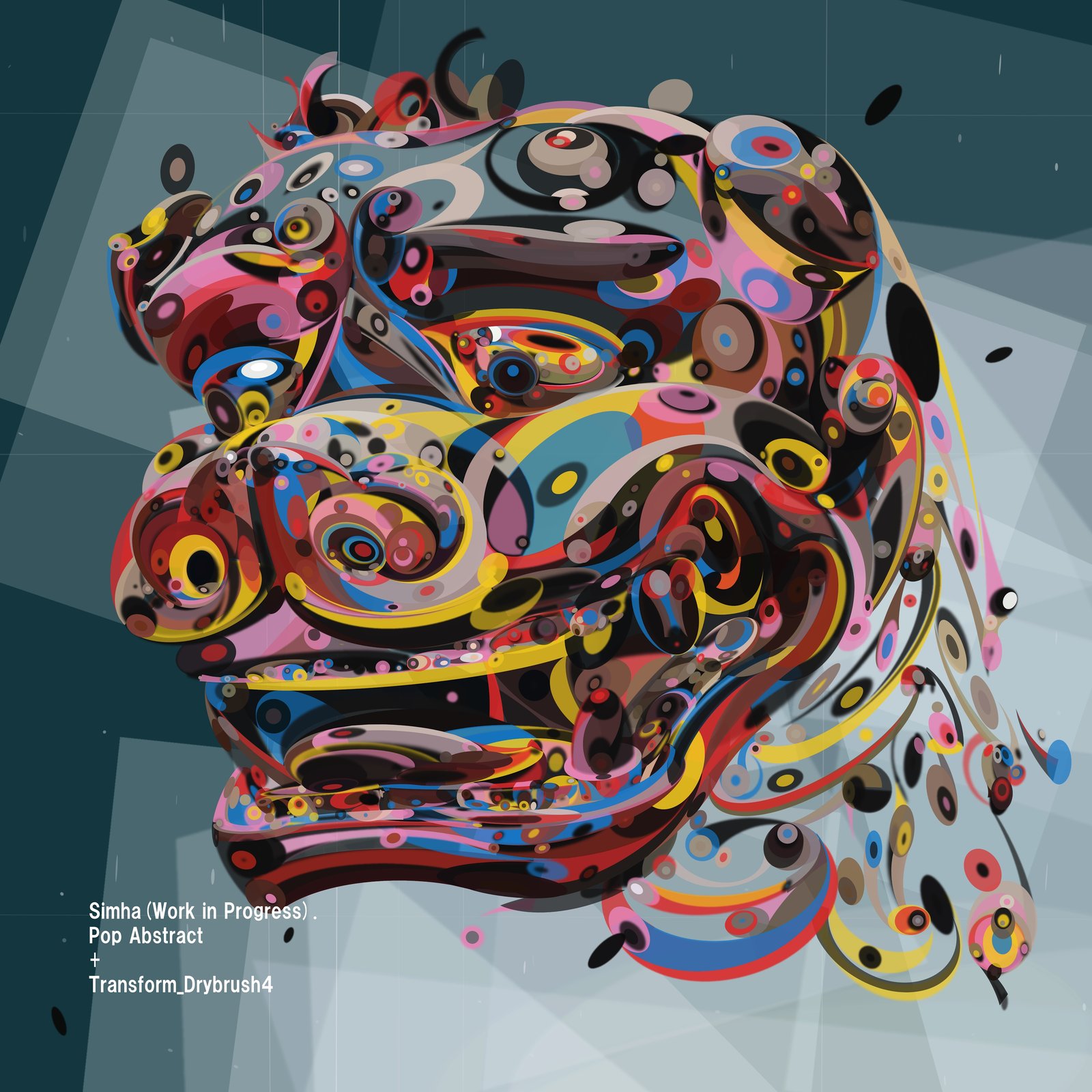
Each creature begins with thousands to tens of thousands of hand-placed AutoShapes, which form its "body" and "soul." Then I generate VBA code through dialogue with AI, edit it within the limits of what I can understand, and use it to trigger destruction and reconstruction. The final form emerges from the interplay of hand drawing × code × unpredictability.
The hand-drawn structure is the soul of the piece — something that never disappears, no matter how much destruction or distortion occurs. It acts as a quiet center that anchors the chaos, allowing the original face or form to remain somewhere within the complexity. AI becomes "a device for destructive ideas," I become "the editor," and VBA becomes "the lightning strike." Together, this triad produces forms that exceed calculation — moments where I become the first witness to the birth of a new life.
"No AI, just PowerPoint + VBA" — why is that important to you?
At first, I wanted to show that complex expression can come from everyday tools. So the combination of PowerPoint + VBA itself was never the essential point. I welcome the use of AI. However, because I create to discover unexpected outcomes, I do not use AI for the parts that determine the final look of the work. Instead, I use AI only as a generator of code ideas — a device for producing unexpected directions. The human hand remains the center, and the code adds "another dimension."
What are you exploring in the motorcycle studies?
In the motorcycle studies, I explore how recognizable forms collapse within layers, geometry, and distortion — and how they rise again. Across all my work, I am exploring my own discoveries: the formation of aesthetic sense, the establishment of my style, technical growth, and unexpected findings. A secondary purpose is to understand what my child finds interesting.
What do you want people to feel when the creatures move and change?
This is the most difficult question. Honestly, any reaction is welcome — I value the viewer's honest response itself. For that reason, I use the hashtag "DigitalDada," inspired by the spirit of Dadaism. I hope the work becomes a point of communication with people who still try to find meaning in it — people like you.
What would a good home for the work look like, beyond the feed?
A place where new information and communication can emerge, and where people can drop by during small moments in their work or creative life — a kind of "home" that exists in the gaps of daily activity.
Anything else you'd like people to know?
ppcreatures began as a shared learning process with my child. I hope they develop the ability to handle "things they don't fully understand," and continue the simple cycle of doing × learning × continuing. My work is still immature in many ways, and I don't know how much it will improve. But I will continue learning from everyone and keep creating.